

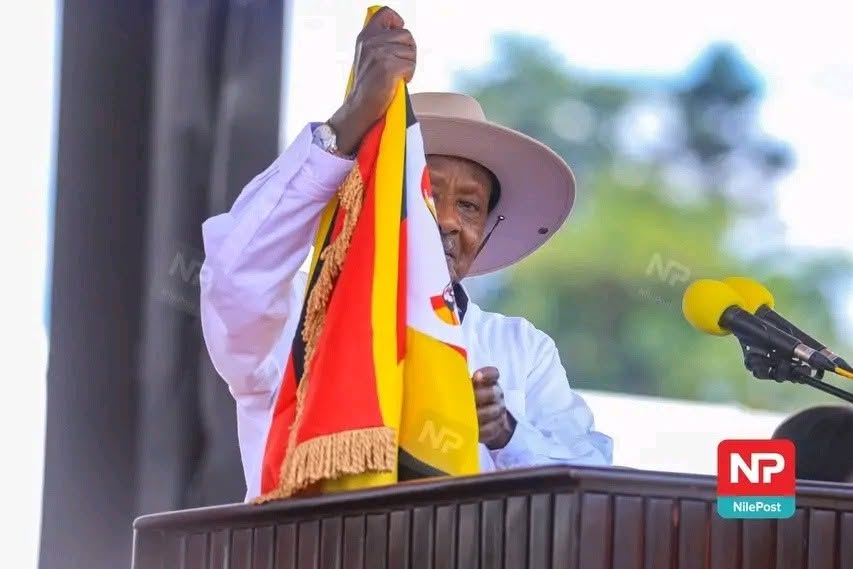
Uganda has entered a new political season.
At least officially.
The President has been sworn in. A new Cabinet is taking oath. Government has assembled its team. The State of the Nation Address has been delivered. The agenda has been laid out.
On paper, everything signals the beginning of another chapter.
But on the streets, in taxis, trading centres, offices and homes across the country, the feeling is harder to define.
There is no national euphoria.
No overwhelming sense of a fresh start.
No political honeymoon.
Instead, there is something more complicated.
Expectation.
Scepticism.
Hope.
Fatigue.
And questions.
Many questions.
For the first time in Uganda's history, a President is beginning a seventh elected term after nearly four decades in power. That reality alone makes this moment unique.
How does a leader who has governed for forty years convince a nation that a new chapter is beginning?
How do citizens separate what is genuinely new from what they have heard before?
And perhaps most importantly, what does "change" look like when the man at the centre of power remains the same?
Those questions formed the heartbeat of Monday's Morning Breeze discussion on NBS TV as Simon Njala hosted Buhweju West MP John Bosco Kariisa and political analyst Dr Daniel Walymera
The conversation quickly exposed the two Ugandas that often emerge whenever Museveni begins another term.
One sees opportunity.
The other sees unfinished business.
One hears a renewed President.
The other hears familiar promises.
For Karisa, the signs of change are already visible.
He points to a President who appears more impatient than before.
More direct.
More demanding.
A President who has declared "Kisanja Hakuna Mukyezo"—No More Sleep—not merely as a slogan but as a warning to government officials, public servants and citizens alike.
The message is clear.
The excuses are over.
The delays are over.
The comfort zones are over.
Everyone must move.
Everyone must work.
Everyone must contribute to the mission of transforming Uganda into a $500 billion economy by 2040.
It is a bold vision.
One that rests heavily on industrialisation, commercial agriculture, tourism, mineral value addition, science and innovation.
In many ways, it is the same dream Museveni has articulated for years—but this time wrapped in a language of urgency.
A language suggesting that the President himself believes time is no longer an unlimited resource.
Perhaps that is what feels different.
Not necessarily the destination.
But the impatience to get there.
Yet outside the corridors of government, a different question lingers.
If this is a new beginning, why doesn't it feel like one?
Political analyst Dr Daniel Walyemera believes the answer lies in the country's political reality.
Many Ugandans, he argues, already knew how the election would end.
There was little suspense.
Little uncertainty.
Little sense of political transition.
And where there is no transition, there is often little excitement.
The result is a country that appears less interested in promises and more interested in performance.
Less interested in declarations and more interested in delivery.
That shift may represent the greatest challenge of Museveni's seventh term.
Forty years in power is both an asset and a burden.
It provides experience.
But it also creates expectations.
Citizens are no longer evaluating promises in isolation.
They are measuring them against decades of previous promises.
Every new commitment inevitably invites an old question:
What happened to the last one?
When the President speaks of industrialisation, some remember earlier industrialisation plans.
When he speaks of jobs, many young Ugandans think about years spent searching for opportunities.
When government speaks of oil wealth, citizens wonder when those benefits will finally reach ordinary households.
This does not mean people have stopped believing.
Far from it.
Ugandans remain remarkably hopeful people.
They continue to build businesses, cultivate land, educate their children and pursue opportunities despite economic hardships.
But hope today is more cautious than it was twenty years ago.
It demands evidence.
That is why the true significance of SONA 2026 may not lie in what the President promised.
It may lie in what Ugandans are now demanding in return.
Results.
Not announcements.
Outcomes.
Not intentions.
Proof.
Not projections.
The Cabinet taking oath this week inherits that reality.
Its ministers are stepping into offices carrying not only the President's agenda but also the accumulated expectations of millions of Ugandans.
For them, the challenge is enormous.
The economy is growing, yet many citizens still struggle.
Infrastructure is expanding, yet service delivery gaps remain.
Investment is increasing, yet unemployment continues to haunt countless young people.
The paradox of modern Uganda is that progress and frustration often exist side by side.
And perhaps nowhere is that contradiction more visible than at the beginning of Museveni's seventh term.
The President insists there will be "No More Sleep."
Many Ugandans agree.
But they are not only looking at civil servants, district officials or parish chiefs.
They are looking at the entire government.
They are looking at ministers.
They are looking at Parliament.
And yes, they are looking at the President himself.
Because after forty years in power, the question is no longer whether Uganda has a vision.
The question is whether that vision can be felt in the daily lives of ordinary citizens.
Whether a farmer earns more.
Whether a graduate finds work.
Whether a trader expands a business.
Whether public services improve.
Whether promises become reality.
As the dust settles on SONA 2026 and the new Cabinet assumes office, Uganda finds itself standing between two powerful emotions.
The hope of what could be.
And the memory of what has not yet been achieved.
The story of Museveni's seventh term will be written somewhere between those two realities.
Not in speeches.
Not in slogans.
But in the lives of the people waiting to see whether this chapter truly turns out differently from the last.